A Professional Prompt for Writing a CV and Cover Letter
Turn real experience into a tailored CV and cover letter with a clear prompt, without inventing achievements or replacing the candidate’s review.
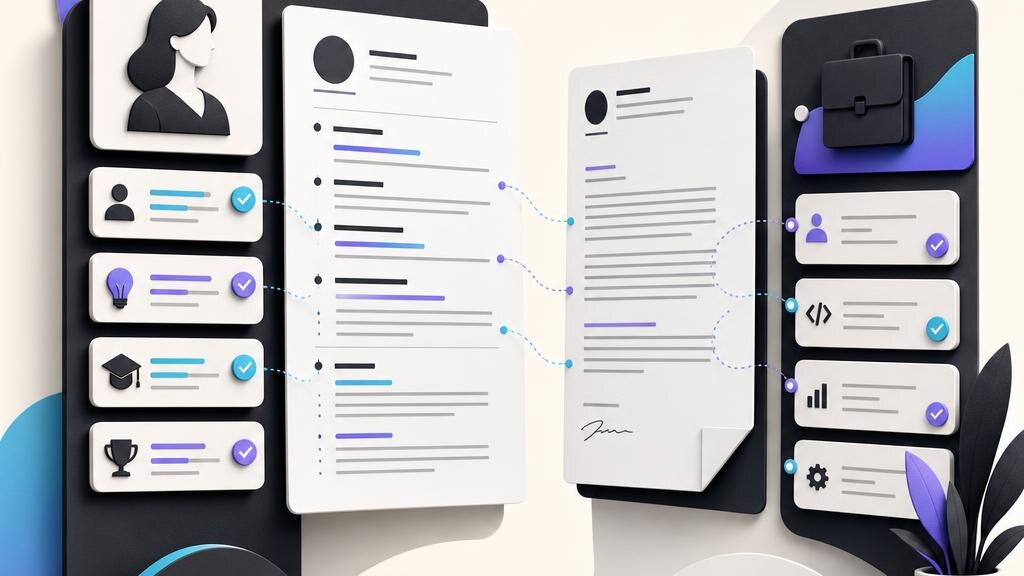
Gather the role and your evidence
The tool does not know your career automatically. Collect the job post, prior titles, projects, provable outcomes, languages, tools, and preferred location or format. Do not guess metrics; write “I do not have the number” and ask for wording that does not imply an unsupported measurement.
Extract required duties, must-have qualifications, and specialist terms from the posting, then compare them with your experience. This is not keyword stuffing: use a term only when it describes work you actually did. Remove identification numbers, addresses, and data the tool does not need.
Prompt for a targeted CV
Try: “You are a recruitment editor. Use my experience and the attached job posting to draft a one-page CV. Order experience by relevance, write action-led bullets, mention outcomes only when I support them, and invent no skill, date, or number. Flag gaps and questions I should answer before submission.”
Request both a plain-text, tracking-system-friendly version and a human-readable version, plus a change list. Specify country, language style, and word limit, then check dates, overlapping periods, and names. A strong CV is accurate and tailored, not merely packed with impressive phrases.
A cover letter with a real reason
A cover letter should not repeat the CV. Ask it to connect two documented achievements to needs in the posting: “Write a 300-word letter to the hiring manager. Open with a specific reason, connect my [project] experience to [requirement], mention what I can learn, and close professionally. Add no claims about the company.”
Put your actual voice back into the draft and edit lines that do not sound like you. Request confident language without exaggeration, and an alternative version if the role needs Arabic or English. Read it aloud and verify the company, title, and recipient; small errors can undermine a good message.
Human review before sending
Use AI as a drafter and reviewer, not as an authority on your qualifications. Verify every claim and ensure examples reflect what you did; ask someone in the field to review relevance. Do not include an achievement you cannot explain in an interview or claim a team result as solely yours.
A practical workflow is to analyze the posting, gather evidence, draft, tailor, check accuracy and privacy, and format a final version for each application. Keep a table of company, version, and date. No wording guarantees an interview, but honesty, clarity, and relevant evidence make your application easier to assess.